Zhishang Steel Co., Ltd
Integrity · Pragmatic · Perfect · Fast · Assured - international brand
Phone: +86-531-88752665
Welcome to Zhishang Steel Co., Ltd.
TEL: (Gavin) +86-15665898999 | Email : info@zhishangsteel.com

Zhishang Steel Co., Ltd
Integrity · Pragmatic · Perfect · Fast · Assured - international brand
Phone: +86-531-88752665

Email:info@zhishangsteel.com
Tel:+86-13964085002
Whatsapp:+86-13964085002
Phone:+86-531-88752665
Message
Someone calls us every few weeks about a gutter or a purlin that has "rusted from the inside out." Almost always, the steel itself is fine. What they are looking at is galvanic corrosion, and it starts in the same place every time: two different metals in contact, with water on top of both.
It is a battery, nothing more mysterious than that. You need a pair of metals with different electrical potential, a path between them, and an electrolyte to carry the current. Rain, condensation, salt spray, even a wet patch of dust will do the job. Take away any one of the three and the reaction stops, which is worth remembering because it tells you where every practical fix comes from. The less noble metal of the pair gives up ions and corrodes; the more noble one just sits there, often looking perfectly fine while its partner eats itself.
Here is the part people forget: this same reaction is what protects galvanized steel in the first place. Zinc is less noble than iron, so when a scratch cuts through the coating on a galvanized steel coil, the zinc around the scratch corrodes preferentially and the exposed steel stays sound. Galvanic corrosion is not the enemy of galvanizing. It is the mechanism that makes galvanizing forgiving. The trick is knowing when it turns from a bodyguard into a problem.
Stainless fasteners on galvanized steel come up most. Stainless sits well above zinc in the galvanic series, so a stainless bolt through galvanized sheet creates exactly the kind of pair you don't want standing in a puddle. In dry inland service, usually nothing dramatic happens for years. Near the coast, or anywhere salt and condensation team up, white corrosion product starts chewing the zinc around the washer within a season or two. The saving grace is one of area: a small fastener against a large sheet puts most of the corrosion load on the tiny anode, but the sheet is a huge cathode, and the damage concentrates right at the bolt hole. Slow overall, ugly locally.
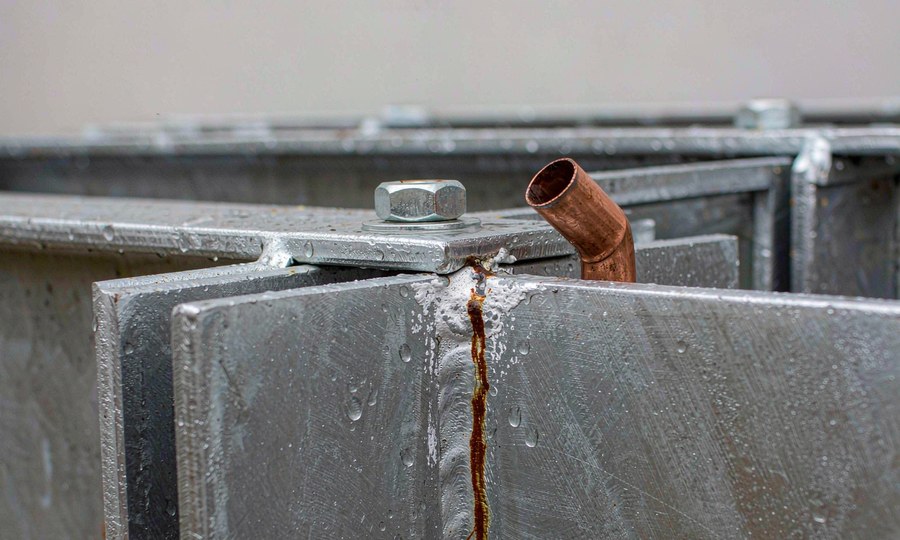
Copper is the worst neighbour steel can have. Run-off water that has touched copper flashing or a copper ridge cap carries just enough copper ion to attack zinc downstream, so a galvanized gutter under a copper roof can corrode from water it never touched. Copper pipe strapped straight to galvanized ductwork does the same at every clip. Aluminium and galvanized steel are close enough in potential that most building codes tolerate direct contact, though in marine atmospheres we would still separate them. For anyone working with copper alloys, whether it's plumbing fittings or a copper alloy like beryllium bronze, the rule is simple: keep copper out of permanent contact with zinc-coated steel, and keep its run-off off the zinc too.
Rarely on the flat face. It starts in crevices, because crevices hold water: under bolt heads, along weld spatter, in the lap where an aluminium sheet sits on a galvanized purlin, at the point where a stainless bracket touches a painted edge that has chipped. Water is the electrolyte, so the details that matter are the details that decide where water sits and for how long. A joint that drains and dries corrodes slowly or not at all. The same joint trapping a teaspoon of rain can go through a coating in a couple of winters. This is why two buildings with the same drawings can age completely differently: one has a site crew who sealed the laps, the other has a crew who stacked the offcuts on the roof.
The fixes are cheap if you plan for them and annoying if you retrofit, so it pays to think about them at ordering stage, not at installation stage.
First, keep the metals apart. Neoprene or EPDM washers under stainless fasteners, nylon bushings where a bracket bolts through, butyl tape between an aluminium sheet and its galvanized frame. A washer costs a cent and does more than any coating you can add afterwards. Painting both faces of a joint works too, because the paint is the electrolyte gap.
Second, control the water. Flashings, drip edges and slope are corrosion protection as much as weather protection. The single most valuable habit on a mixed-metal roof is never letting copper drain onto zinc.
Third, choose compatible metals where you have the choice. On galvanized work, coated carbon-steel or zinc-alloy fasteners usually outperform stainless in wet service simply because they don't set up the battery in the first place. Where stainless is required, order a heavier zinc coating and accept that the fixings are an inspection item, not a fit-and-forget item. Some designs get around the whole problem by switching the neighbouring material: an aluminium gutter coil lets a metal-roofing contractor keep aluminium and steel apart at the gutter line, where the water always ends up.
Fourth, design so the vulnerable detail can be reached and replaced. A washer perishes, a sealant ages. If the joint can be opened, a five-minute maintenance visit fixes what would otherwise be a panel swap.
When we quote a galvanized steel coil for a project, the questions we ask about fixings and neighbouring materials are not small talk. Whether the job will carry stainless bolts, sit near copper, or live by the sea decides what zinc coating weight makes sense and which details need isolating. A customer fabricating enclosures from 304 stainless steel coil that will bolt onto galvanized frames should know about the washer trick before the first hole is punched, not after the white rust appears.
None of this is complicated. The reaction needs contact, water and a potential difference, and you only have to take away one. Most of the galvanic corrosion we see in photographs from customers could have been prevented for less than the cost of the phone call.
Zhishang Steel has always been a pioneer in custom steel and special supplies, and has been recognized for its efforts in enhancing work efficiency and product quality. In addition to ISO9001:2015 certification, we also adhere to strict quality policies and proprietary procedures. If you have any questions, please contact us to provide the best type of product solution for your pre-painted, coil coating metal process, we will closely support after-sales service to ensure that your subsequent problems can be solved in a timely manner, if you have any questions, please send email to info@zhishangsteel.com, we look forward to serving you.

Zhishang Steel, specializing in domestic steel products trade, warehousing, processing and other services. The team has four service teams: Shandong Zhishang Steel Co., LTD., Shandong Zhiyiheng Trading Co., LTD., Tai 'an Zhishang Economic and Trade Co., LTD., Shandong Zhishang Steel Structure Co., LTD. Mainly engaged in steel coil, coated, stee···
▶ When Two Metals Touch: Galvanic Corrosion and How to Break the Circuit
▶ Solar Mounting Steel: What Keeps a PV Array Standing for Twenty-Five Years
▶ Container Rain: Why Steel Arrives Wet and What Actually Prevents It
▶ Your 1.0mm Sheet Measured 0.95mm: Thickness Tolerance Without the Panic
▶ Steel Near the Sea: How to Spec Sheet and Coil for Salt Air
▶ Zinc-Aluminium-Magnesium Coated Steel: Where It Wins, Where It Doesn't
▶ Roof Sheet Geometry: Purlin Spacing, Lap Lengths and the Pitch That Decides the Rest
▶ Why Two Batches of the Same RAL Colour Don't Match: Delta E and Colour Tolerance
▶ As-Rolled, Normalized, TMCP or Quenched: What Delivery Condition Changes About Your Steel
▶ Salt Spray Hours: What 500 Hours on a Test Panel Really Says About Coated Steel
Email:info@zhishangsteel.com
Tel:+86-13964085002
Whatsapp:+86-13964085002
Phone:+86-531-88752665
Message 


Copyright © 2022 Zhishang Steel Co., Ltd All Rights Reserved. XML Map