Zhishang Steel Co., Ltd
Integrity · Pragmatic · Perfect · Fast · Assured - international brand
Phone: +86-531-88752665
Welcome to Zhishang Steel Co., Ltd.
TEL: (Gavin) +86-15665898999 | Email : info@zhishangsteel.com

Zhishang Steel Co., Ltd
Integrity · Pragmatic · Perfect · Fast · Assured - international brand
Phone: +86-531-88752665

Email:info@zhishangsteel.com
Tel:+86-13964085002
Whatsapp:+86-13964085002
Phone:+86-531-88752665
Message
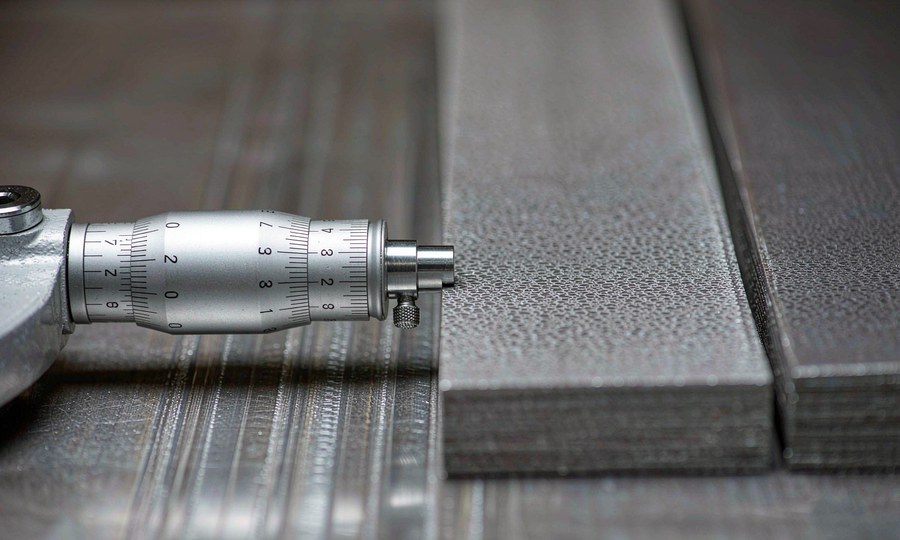
A buyer unloads a coil, puts a micrometer on the sheet, and calls us: the label says 1.0 mm, my gauge reads 0.95. Is this short material? Should I claim? The honest answer, nine times out of ten, is that nothing is wrong - the steel is inside the tolerance the standard allows, and the conversation that follows is about what "1.0 mm" actually means in the steel business. It is worth understanding before your next order, because thickness tolerance quietly affects weight, price, and what your press brake feels on the first stroke.
No rolling mill on earth holds every point of a coil at exactly 1.000 mm, and the standards do not ask them to. Thickness tolerances are written into the same documents that define the grades - EN 10130 and EN 10131 for cold rolled material, EN 10051 for hot rolled strip, ASTM A924 for the general requirements behind metallic-coated sheet, and the GB/T equivalents our domestic mills work to. The idea is the same in all of them: for a nominal thickness around 1.0 mm, the permitted deviation is a few hundredths of a millimetre, tightening for thinner sheet and widening a little as width increases.
Two details matter more than the headline number. First, most standards offer more than one category - a normal tolerance and a tighter "special" one that costs more because it throws away more yield at the mill. Second, coated products are usually toleranced on the base metal, not the coated product, which surprises people measuring a painted sheet. If you order a PPGI color coated steel coil with 20 microns of paint on each face, a micrometer across the coating will read higher than the base thickness on the label - that is paint, not missing steel.
A strip mill rolls a coil in well under a minute. During that minute the strip speeds up as the coil grows, the rolls heat up and crown slightly, and the front end of the coil is always a little different from the tail. Mills compensate with automatic gauge control, but some spread along the length is physics, not carelessness. That is why a sensible check samples several points - head, middle, tail, both edges, centre - instead of trusting one reading taken where the fork truck set the coil down.
Edge condition plays a role too. A coil slit at the mill measures differently at the edge than in the body, and a sheared blank with a rolled edge can give a falsely low reading if the micrometer anvil sits on the burr.
Temperature is the sneaky one. Steel grows roughly a hundredth of a millimetre per metre for every ten degrees, and a coil fresh off a hot rolling line or out of a sunny yard is not the same temperature as your inspection bench. The difference is small at sheet thickness, but if you measure a warm coil and then measure again the next morning after it has cooled overnight, do not be surprised if the two numbers disagree by a point or two of a millimetre. Standards written for verification assume a settled, room-temperature sample for exactly this reason.
Here is the part with financial teeth. Theoretical weight is calculated from nominal thickness; the scale reads what the coil actually weighs. If a coil runs at the bottom of its tolerance, it weighs less than the theoretical figure for the same length, which is exactly why some sellers like quoting by theoretical weight and some buyers insist on actual weighbridge tickets. Neither side is cheating - they are just choosing who carries the tolerance risk.
If your fabrication genuinely needs meat on the sheet - deep drawing, threaded holes, a galvanizer who warns you about distortion - say so when you order. Requesting the tighter tolerance category, or specifying a minimum actual thickness, is a normal commercial request and we price it honestly. Gauge names deserve a caution flag as well: "18 gauge" does not mean one exact number, it maps to a small range that also shifts once the galvanizing layer goes on, which is why our 18ga galvanized steel sheet page describes it as roughly 1.2 to 1.3 mm rather than a single decimal.
Use a micrometer with a flat anvil and a ratchet stop, not calipers - a caliper jaw flexes and reads low. Measure base metal where the coating is stripped or chemically removed, or use an ultrasonic gauge for coated product. Take at least ten readings spread along the coil and across the width, and write down where each came from. Then compare the average against the tolerance table for the standard you bought to, not against the nominal number alone.
On our side, we quote cold rolled steel coil and hot rolled carbon steel plate to the standard you name, we state the tolerance category when it matters, and we are happy to add a weighing clause to the contract if actual weight is how you want to settle. The steel you receive will still vary a few hundredths from the label. What it will not do is vary outside the standard - and now you know how to prove that to yourself before the container is even unpacked.
Zhishang Steel has always been a pioneer in custom steel and special supplies, and has been recognized for its efforts in enhancing work efficiency and product quality. In addition to ISO9001:2015 certification, we also adhere to strict quality policies and proprietary procedures. If you have any questions, please contact us to provide the best type of product solution for your pre-painted, coil coating metal process, we will closely support after-sales service to ensure that your subsequent problems can be solved in a timely manner, if you have any questions, please send email to info@zhishangsteel.com, we look forward to serving you.

Zhishang Steel, specializing in domestic steel products trade, warehousing, processing and other services. The team has four service teams: Shandong Zhishang Steel Co., LTD., Shandong Zhiyiheng Trading Co., LTD., Tai 'an Zhishang Economic and Trade Co., LTD., Shandong Zhishang Steel Structure Co., LTD. Mainly engaged in steel coil, coated, stee···
▶ Your 1.0mm Sheet Measured 0.95mm: Thickness Tolerance Without the Panic
▶ Steel Near the Sea: How to Spec Sheet and Coil for Salt Air
▶ Zinc-Aluminium-Magnesium Coated Steel: Where It Wins, Where It Doesn't
▶ Roof Sheet Geometry: Purlin Spacing, Lap Lengths and the Pitch That Decides the Rest
▶ Why Two Batches of the Same RAL Colour Don't Match: Delta E and Colour Tolerance
▶ As-Rolled, Normalized, TMCP or Quenched: What Delivery Condition Changes About Your Steel
▶ Salt Spray Hours: What 500 Hours on a Test Panel Really Says About Coated Steel
▶ Hardness Isn't Strength: How to Read the Mechanical Property Line on a Mill Certificate
▶ Coating Adhesion and the T-Bend: Why Paint Sticks to Some Coils and Not Others
▶ Heat Numbers: How One Stamped Code Follows Your Steel From Furnace to Door
Email:info@zhishangsteel.com
Tel:+86-13964085002
Whatsapp:+86-13964085002
Phone:+86-531-88752665
Message 



Copyright © 2022 Zhishang Steel Co., Ltd All Rights Reserved. XML Map
