Zhishang Steel Co., Ltd
Integrity · Pragmatic · Perfect · Fast · Assured - international brand
Phone: +86-531-88752665
Welcome to Zhishang Steel Co., Ltd.
TEL: (Gavin) +86-15665898999 | Email : info@zhishangsteel.com

Zhishang Steel Co., Ltd
Integrity · Pragmatic · Perfect · Fast · Assured - international brand
Phone: +86-531-88752665

Email:info@zhishangsteel.com
Tel:+86-13964085002
Whatsapp:+86-13964085002
Phone:+86-531-88752665
Message
Roof sheets almost never fail because the coating was the wrong colour or the steel came from the wrong mill. They fail at a lap, at a fixing, or because the roof was built at a pitch the profile never wanted. All three come back to geometry that gets settled before anyone opens a box of screws.
Water on a metal roof does not need much slope to run off, but it does need enough to stop sitting in the pans. When a roof is too shallow, three things happen at once. Water lingers. Dust and leaf litter hold moisture against the coating. And the end laps start behaving like capillaries, drawing water uphill into a joint that looked perfectly tight on the drawing.
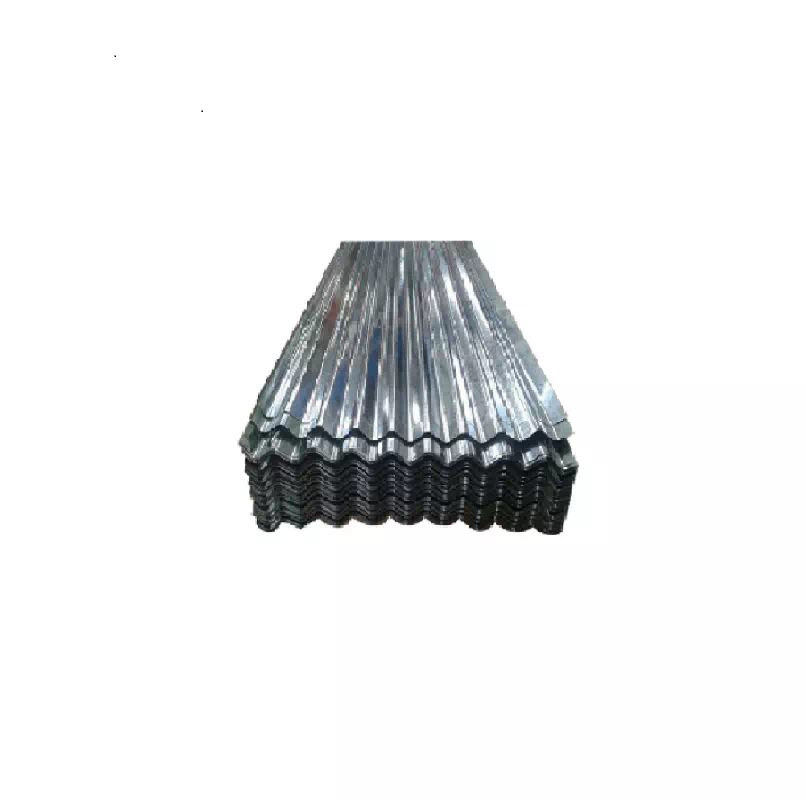
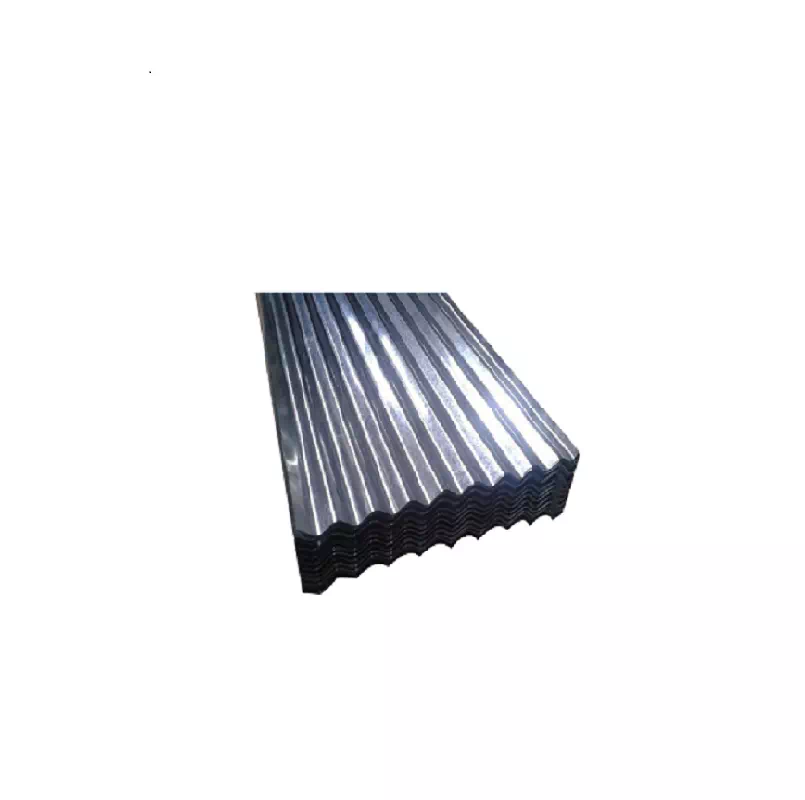
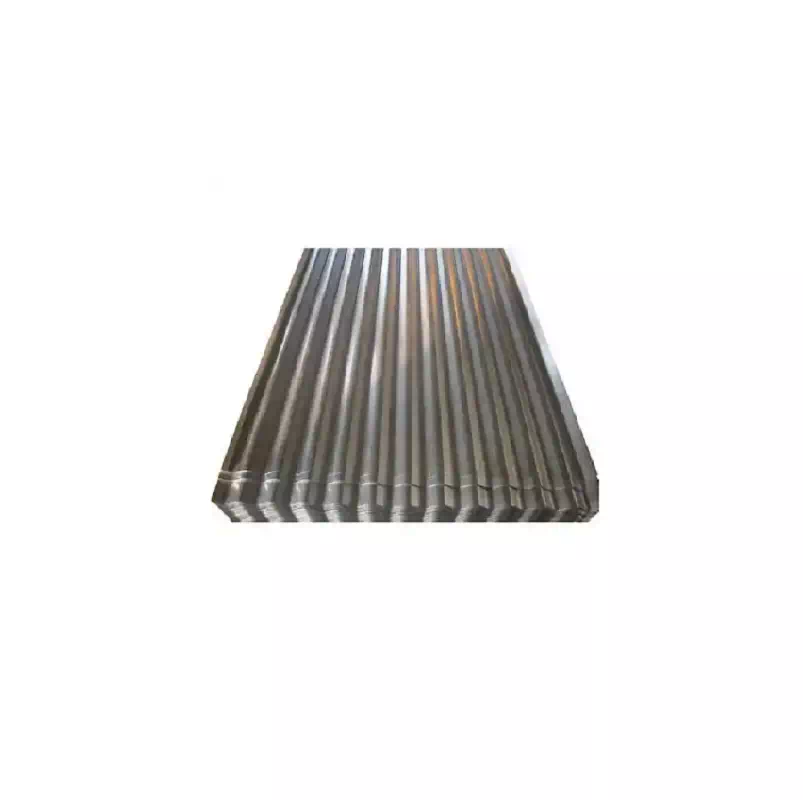
Sinusoidal corrugated profiles are the least forgiving here, because the corrugations are shallow — a plain galvanized roofing sheet in a corrugated profile gives water very little to run against. Installers generally want 1:6 or steeper, roughly ten degrees, whenever the sheets are end-lapped. Trapezoidal profiles with a raised anti-lap rib tolerate less and can often go down to about 1:10. Continuous lengths with no end lap can go shallower still. Below about three degrees you are no longer in screw-fixed sheet territory at all — that is concealed-fix and standing-seam work, with different sheets and a much larger budget.
Rainfall intensity matters as much as pitch. A roof that sheds cleanly in a dry climate can back up under a tropical downpour, particularly where a valley or a change of pitch dumps one roof's water onto another.
Purlin spacing gets treated as a tradition — we always use 1.2 m — when the number should come off the sheet supplier's span table. It is driven by wind uplift, snow load, sheet thickness and profile depth. Foot traffic during installation is a fourth load case and the one most often forgotten. A 0.40 mm sheet on 1,000 mm purlin centres feels like a trampoline under a 90 kg installer. The same span with 0.60 mm sheet is a completely different experience.
Deflection usually limits the span, not bending strength. Panels that are strong enough but too flexible will pump under gusting wind, and every cycle works the fixings a little looser. Limits of span/150 to span/200 are common in the tables, but read the actual table for the actual profile rather than assuming.
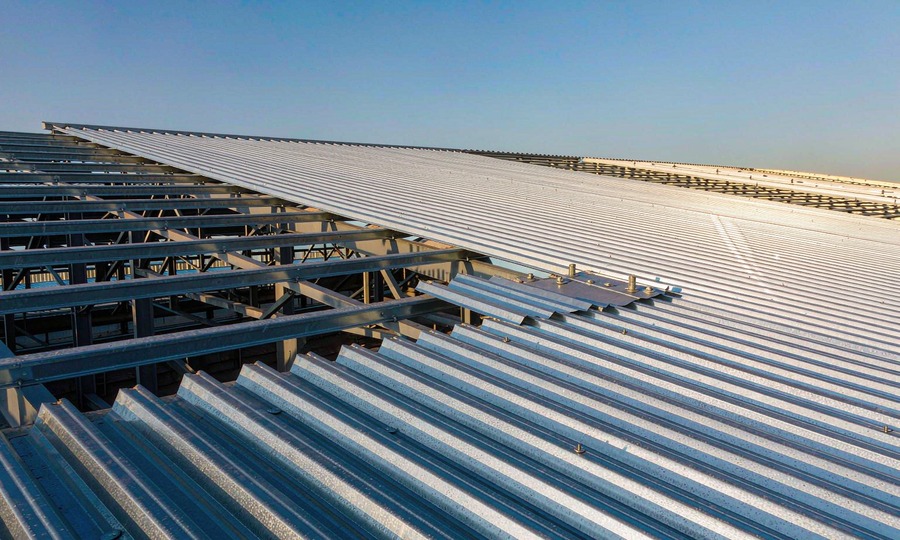
Then there are the edges. Wind uplift peaks at corners, eaves and the ridge, and that is exactly where pull-out failures begin. Purlins go closer together in those zones and the fixing pattern gets denser. Getting the field of the roof right and the perimeter wrong is the classic way to end up with a roof that performs for two years and then starts to rattle.
An end lap is where one sheet runs over the next, down the slope. A common minimum is 150 mm, but that assumes a reasonable pitch. On a shallow roof, 200 to 300 mm is more realistic. The lap should never point into the prevailing wind either — water runs downhill over the lap, not into it.
Side laps are simpler. Sinusoidal profiles normally take a full corrugation. Trapezoidal profiles take one rib, or one and a half in exposed coastal locations. Stitch screws through the side lap at 300 to 500 mm centres hold the sheets to each other, so one panel cannot lift and start a chain reaction along the roof.
More overlap is not automatically safer. Every extra millimetre of lap is another row of fixings and another potential leak line, and a roof covered in 300 mm laps where 150 mm would have done starts to look like patchwork. Sealant tape at the lap does help on shallow roofs, but it is not a substitute for lap length. Butyl dries out eventually, and when it does the water finds the gap.
One point worth repeating, because it produces more complaints than anything else: cut the sheets with a nibbler or hand shears, never an angle grinder. Grinding sparks are hot steel particles. They embed in the coating and rust into small brown speckles within a couple of months. Buyers then send photos of what they call coating failure, when it is really a cutting method problem.
Trapezoidal sheets are normally fixed through the crest, corrugated profiles usually through the valley. Follow the profile manufacturer rather than the installer's habit. The screw also has to match the purlin underneath — a self-drilling screw designed for 1.5 mm steel will strip or walk when it meets a thin cold-formed purlin.
EPDM washers need to be compressed, not crushed. The screw gun should stop when the washer is slightly domed and the seal has formed. Give it another half turn and the washer splits. Two seasons later it leaks, and the repair is a re-roof.
Long runs move. A 20 m length of coated sheet grows and shrinks by a few millimetres between a cold night and a hot afternoon, and that movement has to go somewhere. Fix tightly at one end and let the sheet slide at the other, or the screws will slowly enlarge their own holes. Never re-drill and reuse a hole; it has already lost its grip.
Thinner sheet is not simply cheaper. A 0.40 mm base on a small domestic roof with purlins at 900 mm is perfectly sensible. That same sheet on an industrial shed with 1,500 mm purlins will oil-can, hold water in the pans and show every footstep. Profiles are designed around a base metal thickness range, and going below it changes the whole structural calculation, not just the price.
Coating weight should follow the exposure. Coastal sites and industrial atmospheres justify a heavier coating — think Z275 on a galvanized steel coil, or an aluminium-zinc alloy coating — while dry inland sites rarely need the top of the range. Colour is usually treated as an aesthetic decision, but a light colour on a PPGL colour coated coil keeps the sheet measurably cooler, which matters on an uninsulated shed far more than most people expect.
Cut edges are bare steel by definition, and flashings and ridge capping cut from the same galvanized steel sheet will show light edge rusting over time. That is normal and slow, not a reason to reject a sheet, though it is a good reason to keep material dry on site before installation. Sheets stacked flat in the open for three weeks will develop white rust between them where moisture sat in the stack. That is not a manufacturing defect, and it is entirely avoidable with dunnage under the stack and a cover that lets air move through.
Almost every roofing argument we get pulled into ends with the same sentence: that is how we always do it. Pitch, purlin spacing and lap length are not preferences. They come off a span table, a wind map and a rainfall figure, and they are far cheaper to get right on paper than on a finished roof.
Zhishang Steel has always been a pioneer in custom steel and special supplies, and has been recognized for its efforts in enhancing work efficiency and product quality. In addition to ISO9001:2015 certification, we also adhere to strict quality policies and proprietary procedures. If you have any questions, please contact us to provide the best type of product solution for your pre-painted, coil coating metal process, we will closely support after-sales service to ensure that your subsequent problems can be solved in a timely manner, if you have any questions, please send email to info@zhishangsteel.com, we look forward to serving you.

Zhishang Steel, specializing in domestic steel products trade, warehousing, processing and other services. The team has four service teams: Shandong Zhishang Steel Co., LTD., Shandong Zhiyiheng Trading Co., LTD., Tai 'an Zhishang Economic and Trade Co., LTD., Shandong Zhishang Steel Structure Co., LTD. Mainly engaged in steel coil, coated, stee···
▶ Roof Sheet Geometry: Purlin Spacing, Lap Lengths and the Pitch That Decides the Rest
▶ Why Two Batches of the Same RAL Colour Don't Match: Delta E and Colour Tolerance
▶ As-Rolled, Normalized, TMCP or Quenched: What Delivery Condition Changes About Your Steel
▶ Salt Spray Hours: What 500 Hours on a Test Panel Really Says About Coated Steel
▶ Hardness Isn't Strength: How to Read the Mechanical Property Line on a Mill Certificate
▶ Coating Adhesion and the T-Bend: Why Paint Sticks to Some Coils and Not Others
▶ Heat Numbers: How One Stamped Code Follows Your Steel From Furnace to Door
▶ Flatness, Camber and Edge Wave: Reading the Shape of a Coil Before It Costs You
▶ Q235, A36, S235JR, SS400: Four Names for (Almost) the Same Steel
▶ Zinc Coating Weight, Explained: What Z100, Z275 and AZ150 Actually Mean
Email:info@zhishangsteel.com
Tel:+86-13964085002
Whatsapp:+86-13964085002
Phone:+86-531-88752665
Message 



Copyright © 2022 Zhishang Steel Co., Ltd All Rights Reserved. XML Map