Zhishang Steel Co., Ltd
Integrity · Pragmatic · Perfect · Fast · Assured - international brand
Phone: +86-531-88752665
Welcome to Zhishang Steel Co., Ltd.
TEL: (Gavin) +86-15665898999 | Email : info@zhishangsteel.com

Zhishang Steel Co., Ltd
Integrity · Pragmatic · Perfect · Fast · Assured - international brand
Phone: +86-531-88752665

Email:info@zhishangsteel.com
Tel:+86-13964085002
Whatsapp:+86-13964085002
Phone:+86-531-88752665
Message
Every few months a buyer asks us for a thousand hours of salt spray, and the honest answer is that the number matters far less than what happens to the panel. A 1,000-hour result on a flat untreated sample can sit next to a 240-hour result on a scribed one and tell you roughly the same thing about how the material will behave on a roof in a coastal town.
Salt spray testing is a comparison tool, not a service-life prediction. Knowing which of the two you are looking at saves a lot of arguing later.
The usual reference is ISO 9227. A coated steel panel goes into a chamber, gets fogged with a saline solution, and stays there at a controlled temperature for a set number of hours. The neutral version, NSS, runs at 5% sodium chloride, pH roughly 6.5 to 7.2, and 35°C. Duration is whatever the specification asks for: 72, 240, 480, 720, 1,000 hours and beyond.
For prepainted products there is often a second reference, ASTM B117, the American equivalent built on the same idea with slightly different tolerances. If a customer writes B117 while we are quoting to ISO 9227, the two are close enough for most commercial decisions, though not identical in the fine print.
This is where most of the confusion starts. What goes into the chamber is a small flat coupon cut from a coated sheet. What arrives at your site is a coil, or a bundle of sheets, or a stack of formed panels with sheared edges, punched holes and hundreds of metres of cut length.
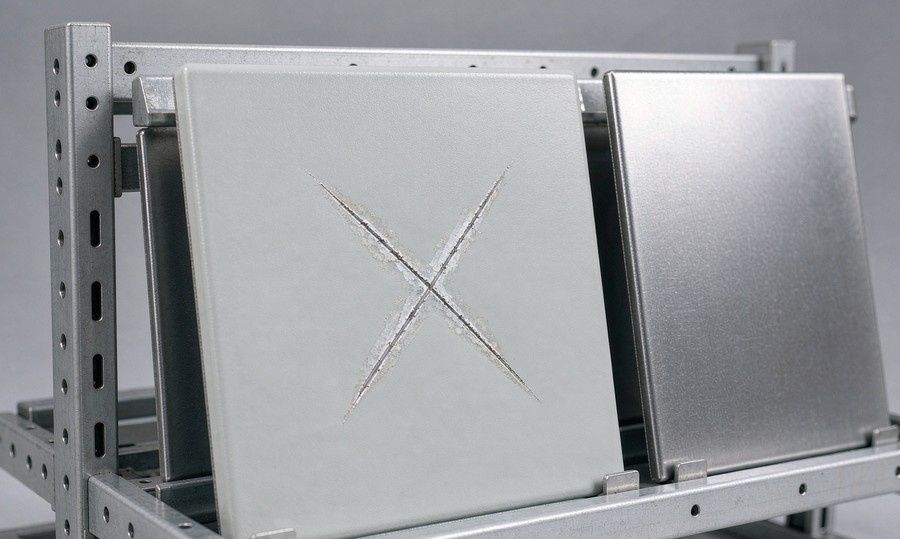
Corrosion on coated steel starts at damage. A sheared edge exposes bare steel, and the zinc or aluminium-zinc layer has to protect it by sacrificial action until that exposed strip is consumed. A scribed line through the paint does the same thing in a more controlled way, which is why buyers who care about real performance ask for a scribed panel, a bend test, or a T-bend alongside the salt spray. A number without the panel preparation is half a data point.
Three things matter on a report.
Where the failure is. White rust on a galvanized surface is zinc corrosion product — that is the coating doing its job. Red rust means the steel underneath has been reached. "White rust at 480 hours, no red rust" is good news. "Red rust at 72 hours" is not, and it usually points to a coating weight problem or a badly cut edge.
How far it spread from the damage. A scribe creep measurement — how far corrosion has travelled sideways from the line that was cut — tells you more than a simple pass or fail. One millimetre of creep is a different story from five.
What the coating weight was. Salt spray hours and zinc coating weight travel together. A Z275 hot-dip galvanized steel coil and a Z100 are not expected to behave identically in a chamber, and a result quoted without the coating weight is not comparable to anything. This is part of why aluminium-zinc and zinc-aluminium-magnesium coatings can be specified with lower coating masses: the alloy layer protects a cut edge differently from pure zinc.
A salt spray chamber is one accelerated environment and nothing else. No ultraviolet light. No wet-dry cycling. No sulphur dioxide, no temperature swings, no rain washing the surface, and no time for the coating to chalk and erode. A roof in a real climate sees all of that, plus mechanical damage from foot traffic and fixings.
Which is why published correlations between salt spray hours and years of service are broad ranges at best. The test is excellent for comparing two candidate materials under identical conditions. It is poor at promising that a panel will last a specific number of years in a specific place. For that you need outdoor exposure sites and years of field data, and nobody has those on the afternoon they need to place an order.
If you are writing a specification, say what you are testing for. A reasonable line for a PPGI colour coated coil destined for roofing might ask for neutral salt spray to ISO 9227, scribed panel, stated coating mass, and a defined acceptance limit — no red rust and creep under 2mm at 480 hours, for instance. That gives a mill something to aim at and gives you something to compare across suppliers.
If you are buying galvanized steel sheet for an inland warehouse, 240 hours is usually plenty. Coastal, industrial, or anywhere near a road that gets salted in winter, push the coating weight up before you push the test hours. More hours on a thin coating only proves that a thin coating is thin.
Ask for the test to be run on material from the actual production lot, or at minimum on the same specification. A certificate from a trial run two years ago on a different line is a nice document and very little else. Buyers who understand that tend to get better answers, because they ask questions a mill can actually answer with data. When you are comparing a corrugated galvanized roofing sheet from three different mills, that difference is usually what separates a real comparison from three pieces of paper.
Zhishang Steel has always been a pioneer in custom steel and special supplies, and has been recognized for its efforts in enhancing work efficiency and product quality. In addition to ISO9001:2015 certification, we also adhere to strict quality policies and proprietary procedures. If you have any questions, please contact us to provide the best type of product solution for your pre-painted, coil coating metal process, we will closely support after-sales service to ensure that your subsequent problems can be solved in a timely manner, if you have any questions, please send email to info@zhishangsteel.com, we look forward to serving you.

Zhishang Steel, specializing in domestic steel products trade, warehousing, processing and other services. The team has four service teams: Shandong Zhishang Steel Co., LTD., Shandong Zhiyiheng Trading Co., LTD., Tai 'an Zhishang Economic and Trade Co., LTD., Shandong Zhishang Steel Structure Co., LTD. Mainly engaged in steel coil, coated, stee···
▶ Salt Spray Hours: What 500 Hours on a Test Panel Really Says About Coated Steel
▶ Hardness Isn't Strength: How to Read the Mechanical Property Line on a Mill Certificate
▶ Coating Adhesion and the T-Bend: Why Paint Sticks to Some Coils and Not Others
▶ Heat Numbers: How One Stamped Code Follows Your Steel From Furnace to Door
▶ Flatness, Camber and Edge Wave: Reading the Shape of a Coil Before It Costs You
▶ Q235, A36, S235JR, SS400: Four Names for (Almost) the Same Steel
▶ Zinc Coating Weight, Explained: What Z100, Z275 and AZ150 Actually Mean
▶ Weathering Steel: Why the Rust on Purpose Actually Protects
▶ Spangle, Skin-Pass and Passivation: Reading the Surface of a Galvanized Steel Coil
▶ Printed and Patterned Color Coated Coil: How Wood Grain and Brick Patterns Get Onto Steel
Email:info@zhishangsteel.com
Tel:+86-13964085002
Whatsapp:+86-13964085002
Phone:+86-531-88752665
Message 


Copyright © 2022 Zhishang Steel Co., Ltd All Rights Reserved. XML Map