Zhishang Steel Co., Ltd
Integrity · Pragmatic · Perfect · Fast · Assured - international brand
Phone: +86-531-88752665
Welcome to Zhishang Steel Co., Ltd.
TEL: (Gavin) +86-15665898999 | Email : info@zhishangsteel.com

Zhishang Steel Co., Ltd
Integrity · Pragmatic · Perfect · Fast · Assured - international brand
Phone: +86-531-88752665

Email:info@zhishangsteel.com
Tel:+86-13964085002
Whatsapp:+86-13964085002
Phone:+86-531-88752665
Message
Every steel exporter eventually has a conversation that goes something like this: the customer has 28 tonnes of coil, the booking says 40'HQ, and somebody assumes it all fits. It does not. A 40-foot high cube has a max gross payload around 26–28 tonnes depending on the shipping line and the road regulations at both ends, and in most destination countries the legal road limit is actually lower than the container itself allows. So before we even think about lashing, we do the arithmetic. How many tonnes can this box legally carry on a truck in, say, Manila or Lagos or Santos? That number, not the container's paper rating, decides how the order gets split.
This is why our sales team asks about destination port and final delivery address so early. A customer who needs door delivery to an inland city often ends up with two 20-foot containers instead of one 40-foot, purely because of axle weight rules. Splitting costs money, but an overloaded truck that gets fined or refuses to move costs more.
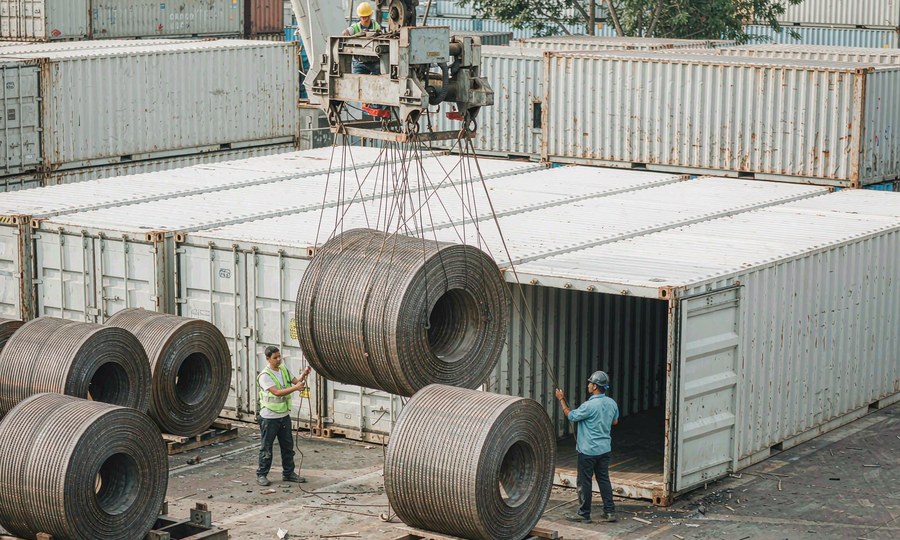
The hardest cargo to load is the cargo that wants to move. A coil of carbon steel coil is essentially a cylinder of solid steel weighing three to ten tonnes, and a cylinder on a flat floor rolls with very little encouragement. Ship a coil loose in a container and one hard braking event on the motorway to the port can turn it into a wrecking ball that cuts through the container wall. Insurance adjusters call this "cargo shifting" and it is one of the most preventable causes of claims in our industry.
So coils go on cradles. We weld or bolt timber cradles to the container floor, set each coil into the V, then wedge it so it physically cannot rotate. Eye-to-sky orientation for narrow coils, eye-to-side for wider ones, depending on width and what the lashing plan needs. After that comes the steel strapping and lashing: each coil gets tied back to the container's lashing points with webbing or wire rope, tensioned properly, not just looped and hope. A good rule we follow: if you can slip a hand under a lashing after tensioning, it is not tight enough.
Bundles of sheet and slit coil behave better than full coils, but they have their own habits. Corrugated and profiled products, including GI sheet in coil form, go in flat with the packaging protected, palletised where the gauge allows. Heavier bundles go on the floor, lighter ones on top, and nothing goes on top of anything that might dent. Painted product is the most sensitive: a bundle of color coated steel coil that arrives with strap marks or rub scratches is a claim waiting to happen, so those coils get extra board protection between wraps and never carry other cargo on top.
Weight distribution matters as much as total weight. Roughly sixty percent of the load should sit over the container's centre line, evenly side to side, with the heavier share slightly forward of centre. A container loaded heavy at one end is a truck that handles badly, and some ports will actually re-work a box that fails their inspection. We have seen it happen to other people's cargo. It is expensive, avoidable, and the kind of story a freight forwarder tells for years.
One more habit worth mentioning: we mark the gross weight and the coil count on a card tucked into the door pocket before sealing, so the first thing the receiver reads is a number they can put on a weighbridge. If the bridge at their end says the same thing the card says, everyone relaxes. If it does not, we know within a day, while the box is still near the port and fixable, instead of three weeks later at a warehouse with no crane nearby.
Before the doors close, we photograph everything: the empty container before loading, the floor and walls for damage, each layer as it goes in, every lashing point after tensioning, and the loaded box with doors open and closed. The customer gets this set with the shipping documents. On the rare occasion something arrives wrong, those photos settle the argument in an afternoon instead of a month. Between the factory and the port there are always a few people who had no part in the original loading, and good photos are the only memory the container carries.
None of this is complicated. It is carpentry, arithmetic and stubbornness, repeated for every single box. But the first thing a customer sees of us is not the steel, it is the container doors opening at their warehouse. What falls out of that box, and in what condition, is the whole reputation in one moment. That is the way we look at it, anyway, and it is why our loading team gets the final say on whether a box is ready to seal.
Zhishang Steel has always been a pioneer in custom steel and special supplies, and has been recognized for its efforts in enhancing work efficiency and product quality. In addition to ISO9001:2015 certification, we also adhere to strict quality policies and proprietary procedures. If you have any questions, please contact us to provide the best type of product solution for your pre-painted, coil coating metal process, we will closely support after-sales service to ensure that your subsequent problems can be solved in a timely manner, if you have any questions, please send email to info@zhishangsteel.com, we look forward to serving you.

Zhishang Steel, specializing in domestic steel products trade, warehousing, processing and other services. The team has four service teams: Shandong Zhishang Steel Co., LTD., Shandong Zhiyiheng Trading Co., LTD., Tai 'an Zhishang Economic and Trade Co., LTD., Shandong Zhishang Steel Structure Co., LTD. Mainly engaged in steel coil, coated, stee···
▶ Loading a Container of Steel: What Actually Keeps 27 Tonnes in Place
▶ Stencils, Tags and Shipping Marks: What We Put on Your Steel Before It Leaves the Yard
▶ Your Order Needs a Slot, Not Just a Price: How Our Rolling Schedule Works
▶ The Orders We Turn Down, and What We Suggest Instead
▶ How Payment Works on a Steel Order: T/T, L/C and the Paperwork Behind Both
▶ Third-Party Inspection: What Happens When Your Inspector Shows Up at Our Yard
▶ Painting Over Paint: How We Change Colour on a Coating Line Without Ruining a Coil
▶ Sample Requests: What Happens After You Ask Us for a Piece of Steel
▶ When a Shipment Isn't Right: How We Work Through a Steel Claim
▶ Packing Steel for the Ocean: What Actually Happens Before Your Coil Enters the Container
Email:info@zhishangsteel.com
Tel:+86-13964085002
Whatsapp:+86-13964085002
Phone:+86-531-88752665
Message 



Copyright © 2022 Zhishang Steel Co., Ltd All Rights Reserved. XML Map
